[stock-market-ticker symbols=" ^NYA;CRYPTO:BTC;CRYPTO:ETH;CRYPTO:USDT;CRYPTO:USDC;CRYPTO:BNB;CRYPTO:ADA;CRYPTO:XRP;CRYPTO:SOL;CRYPTO:DOGE " stockExchange="NYSENASDAQ" width="100%" transparentbackground=1 palette="financial-light"]

Home Blog Page 87

The Rise of eSports: Insights from Xen Gaming’s CEO Jordan Lazarus

“Xen has focused heavily on content, but around a month or two ago, we entered the competitive space signing three great players.” – 02:58

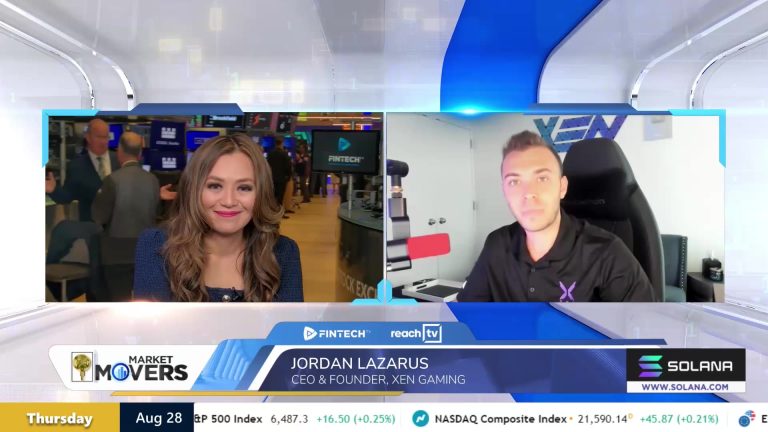
Remy is joined by Jordan Lazarus, the CEO and founder of Xen Gaming, the largest unfunded gaming organization globally, with an impressive following of 45 million and generating hundreds of millions of views each month. Jordan shares insights into Xen’s recent ventures into competitive gaming, particularly highlighting their players Boltz and Rapid, who are set to compete in the highly anticipated Fortnite Championship Series Finals in France on September 6th and 7th. This tournament is one of the most prestigious in the eSports arena, featuring the top 100 players worldwide and a multi-million dollar prize pool.

The conversation shifts to the evolving landscape of sponsorships and partnerships within the eSports industry. Jordan elaborates on Xen’s collaborations with notable brands such as Amazon, Walmart, NASCAR, and Ally Bank, explaining how these companies are entering the gaming space to enhance their visibility and engage with millions of players through innovative marketing campaigns.

As they delve deeper into the Fortnite Championship Series Finals, Jordan provides an overview of Xen’s competitive strategy and the caliber of players they have signed, including Miro, a six-time FNCS winner. With only six spots available in the U.S. for this tournament, the competition is fierce, and the excitement is palpable.
Nvidia’s Earnings: A Mixed Bag Amid Soaring AI Demand

“Even though fundamentally the company is strong, the expectations are higher and it means that a lot of those positive fundamentals and expectations have more or less been priced into the stock.” – 02:31

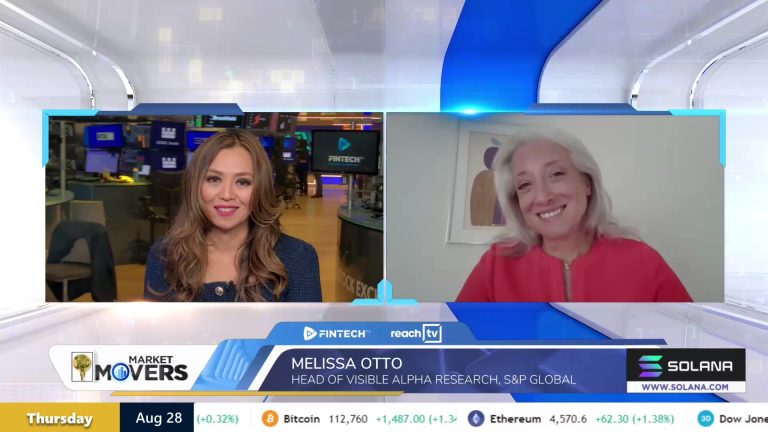
Melissa Otto, Head of Visible Alpha Research at S&P Global, joins Remy Blaire to discuss NVIDIA’s recent earnings report. NVIDIA has announced a staggering $46.7 billion in revenue, marking a 56% increase from the previous year. Despite this impressive growth, the company’s shares experience a dip in after-hours trading due to a slight miss in data center revenue, which is critical for its AI chip sales.

Remy and Melissa explore the high expectations surrounding NVIDIA, noting that while the company remains fundamentally strong, the increasing expectations make it challenging for NVIDIA to deliver the outsized surprises that investors have come to anticipate. They discuss the implications of this trend for the company’s future growth potential and what it means for investors.

The conversation shifts to the aggressive investments being made by major players in the AI sector, including OpenAI, Microsoft, Alphabet, Meta, and Amazon, which have significantly contributed to NVIDIA’s stock price nearly doubling since April. Melissa points out that while the consensus for NVIDIA’s sales remains stable, expenses are on the rise due to increased investments, suggesting that the stock may trade sideways unless a meaningful catalyst emerges.

Caution becomes a key theme in their discussion, particularly regarding NVIDIA’s margins and the potential for future growth. Melissa highlights the company’s impressive margin expansion in its data center segment and raises questions about whether it can maintain this momentum amid rising costs associated with new product developments like Rubin and Blackwell.

The Impact of the Genius Act: A New Era for Stablecoins and Digital Assets

“What we should try to strive for is not tokenizing an asset but actually making sure that the legal tender is actually represented on the chain.” – 05:05

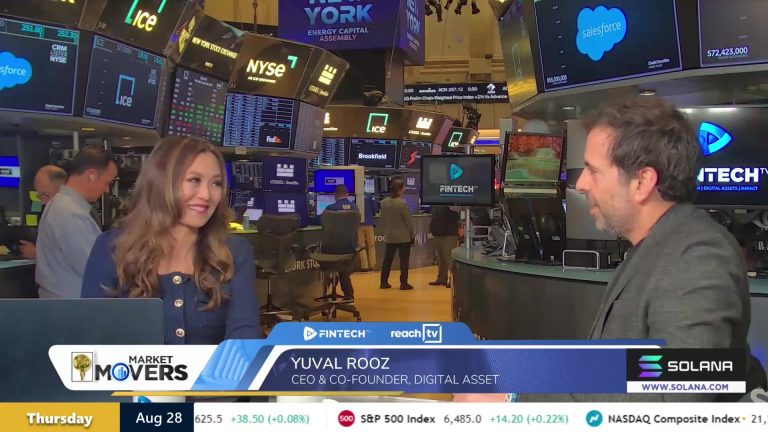
Yuval Rooz, CEO & Co-Founder of Digital Asset, joins Remy Blaire at the New York Stock Exchange to discuss the burgeoning global stablecoin market, which has recently surpassed $280 billion. 

Yuval shares his perspective on the implications of the Genius Act, emphasizing the positive impact of regulatory engagement on the industry. He notes that the support from the U.S. administration and regulators has encouraged clients who were previously cautious about adopting blockchain technology to move forward with confidence.

The conversation shifts to the U.K. and its current approach to stablecoin strategy. Yuval explains that stablecoins have proven to be a successful on-chain use case, prompting governments worldwide, including the U.K. and South Korea, to consider legislation that aligns with the evolving financial landscape. He asserts that as the U.S. accelerates its regulatory framework, other countries are beginning to catch up.

From Whales to DATS: The Shift in Bitcoin Ownership and Yield Generation

“Bitcoin is a stored value natively based off the proof of work chain. It does not generate yield, unlike ETH, unlike Solana, unlike some of these other altcoins.” – 02:32

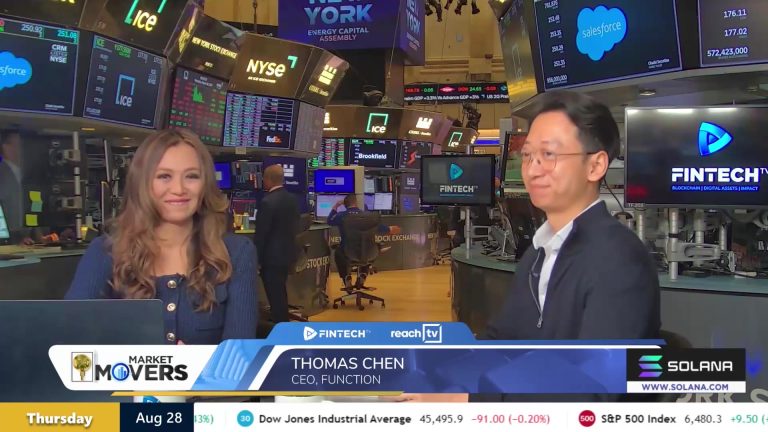
Thomas Chen, CEO of Function, joins Remy Blaire to discuss the increasing institutional adoption of Bitcoin and the implications this trend has for the cryptocurrency market.

Remy opens the segment by highlighting the growing interest from large institutions and “whales” in Bitcoin as a treasury reserve asset. He notes the concerns raised by Bitcoin maximalists regarding the potential risks associated with these entities, particularly the fear that a mass sell-off during a market downturn could lead to a significant crash. The discussion also touches on the contentious issue of lending Bitcoin for yield, which some believe contradicts the fundamental principle of private ownership.

Thomas shares insights into the current accumulation phase of Bitcoin, revealing that digital asset treasury companies have collectively acquired around $100 billion in BTC, with MicroStrategy at the forefront. He emphasizes the critical question of what these companies will do with their Bitcoin once the accumulation phase concludes and how they can deploy it in a productive manner, akin to cash management.

Crypto Currents: Insights on Bitcoin, Ethereum, and Market Sentiment

“The biggest story of the year has been the rotation out of Bitcoin into Ether.” – 01:35

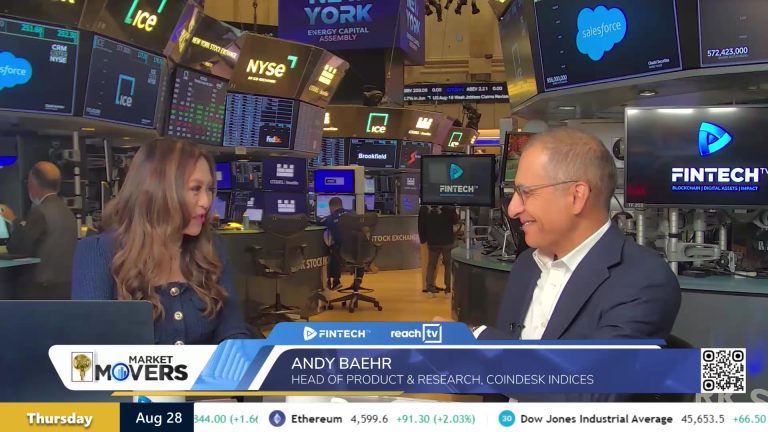
Andy Baehr, Head of Product & Research at Coindesk Indices, joins Remy Blaire to discuss the market’s performance over the past few months, noting that despite some anxiety, the summer has been quite fruitful. Bitcoin’s price has increased from $109,000 on Memorial Day to nearly $113,000, alongside all-time highs for Ethereum. They discuss the implications of the Genius Act’s passage and the excitement surrounding major IPOs, including those of Circle and Bullish.

Andy introduces an intriguing analogy, comparing the current market dynamics to a washing machine, where various factors are influencing sentiment. On the positive side, they note regulatory support, strong trading volumes, and continued adoption of cryptocurrencies. However, there are also concerns about Bitcoin’s recent stagnation and decreased blockchain activity, which has led to a cautious mood among investors.

As the conversation transitions into the back-to-school season, Remy addresses new investors considering entering the crypto market. Andy emphasizes the importance of understanding the fundamentals of Bitcoin and Ethereum, as well as the broader implications of blockchain technology. He advises potential investors to consider their ability to actively manage their investments versus opting for index products.

Looking ahead, they discuss key catalysts to watch for after Labor Day, including interest rates and regulatory developments. The market remains sentiment-driven, and they highlight the importance of staying informed about macroeconomic factors that could influence crypto prices.

Economic blockchain, Trump Media, Kraken tokenization, Anime Onchain

0

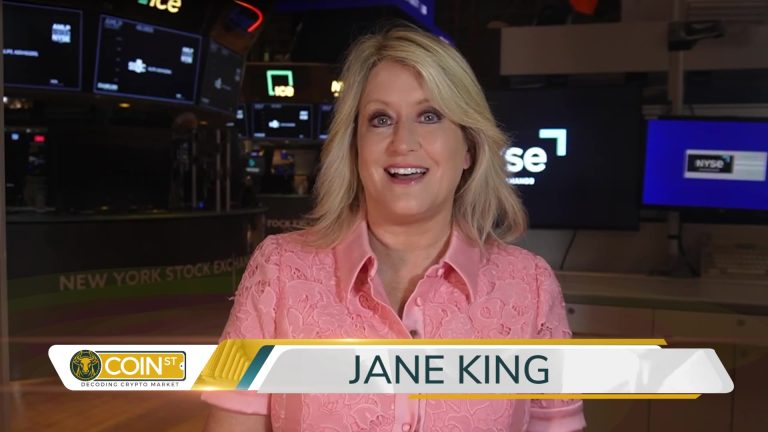
In this episode of Coinstreet headlines, we dive into the latest headlines shaping the world of cryptocurrency and blockchain technology. Join us as we discuss: U.S. Commerce Secretary Howard Lutnick’s groundbreaking initiative to publish GDP data on-chain, with potential expansion across federal departments. Trump Media’s ambitious $6 billion deal with Crypto.com, creating a digital asset treasury company focused on acquiring the Kronos cryptocurrency. Kraken’s recent discussions with the SEC regarding tokenized stocks amidst calls for increased investor protection in traditional markets and finally, the collaboration between Animoca Brands and Ibex Japan to launch a dedicated Web3 entertainment investment fund, aimed at bringing Japan’s beloved anime and manga IP on-chain. Jane King with the latest from the NYSE.

Ethereum’s Historic Milestone: A Deep Dive into Its $500 Billion Market Cap

“We’re looking to what is a decade-long, if not longer, opportunity to rebuild the global financial system on different decentralized rails.” – 01:36

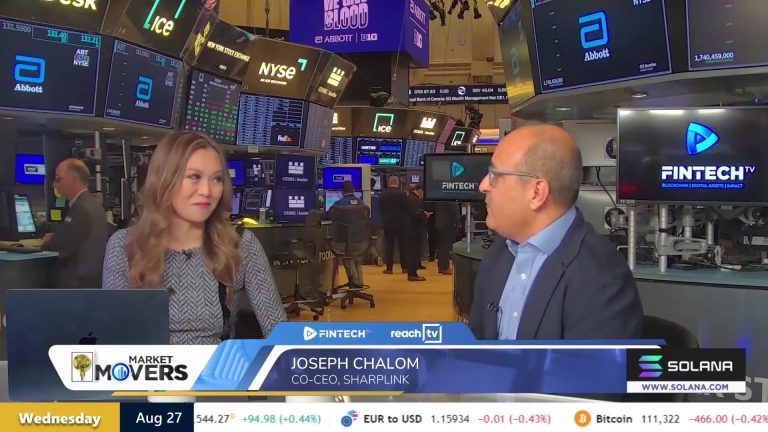
Joseph Chalom, Co-CEO of Sharplink, joins Remy Blaire at the New York Stock Exchange to discuss Ethereum’s recent milestone of reaching a market cap of $500 billion. This achievement marks a faster ascent than that of major companies and even Bitcoin, and it comes alongside a significant doubling of gains for long-term holders. The conversation begins with Remy highlighting Ethereum’s record high of over $4,900, driven by substantial accumulation from institutional investors and whales reallocating capital from Bitcoin to Ethereum.

Joseph shares his insights on the post-Jackson Hole rally, noting a prevailing sentiment that the market is moving towards a dovish stance, which could lead to increased capital infusions. He emphasizes the long-term opportunity that Ethereum presents, particularly in the context of rebuilding the global financial system on decentralized rails. Joseph explains that while Friday’s market performance was positive, Sharplink is focused on a decade-long vision for Ethereum’s potential.

Remy prompts Joseph to clarify the differences between Bitcoin and Ethereum, especially as Ethereum celebrates its 10th anniversary. Joseph describes Ethereum as a decentralized, programmable network that facilitates instant transaction settlements, contrasting it with Bitcoin’s primary function as a store of value. He points out the significant adoption of stablecoins and tokenized assets on the Ethereum network, which has seen a historic growth in DeFi activity.

The Future of Crypto: Bitcoin’s Growth Potential and Ethereum’s Institutional Demand

“For most investors, the right thing to do is to build your position through a dollar cost averaging strategy.” – 02:58

The segment opens with a discussion about a recent flash crash in Bitcoin, which sees its price drop below $111,000 after a whale sells off 24,000 Bitcoin. This significant sell-off triggers forced selling and raises concerns about the market’s stability, especially in light of recent comments made by Federal Reserve Chair Jay Powell.

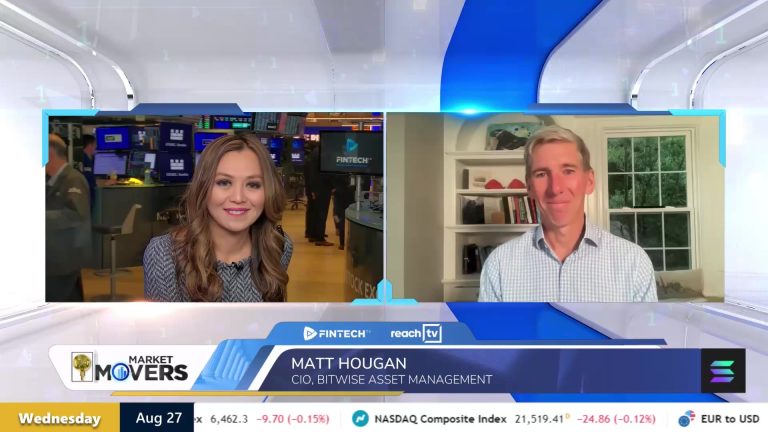
Remy welcomes Matt Hougan, the Chief Investment Officer of Bitwise Asset Management, to provide expert insights on the situation. Matt acknowledges the short-term volatility in the market, noting that August and September are historically challenging months for cryptocurrencies. However, he emphasizes a long-term bullish outlook for Bitcoin, projecting a compound annual growth rate of 28.3% over the next decade. He points out that institutions are expected to need to acquire over a trillion dollars’ worth of Bitcoin in the coming years, driven by rising concerns about debts and deficits and an improving regulatory environment.

The conversation shifts to Ethereum, which has shown strength against Bitcoin, rallying 5% in the previous session. Matt mentions that while the derivatives market for ETH is signaling some overheating, the long-term outlook remains bright due to increasing institutional interest in stablecoins and tokenization.

Democratizing Finance: The Role of CDFIs and MDIs in the Blockchain Era

“It’s about increasing access to digital assets. It’s about increasing financial education.” – 01:23

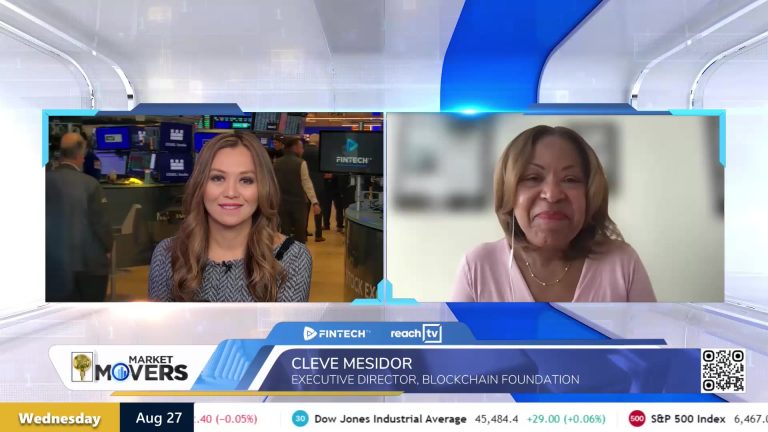
Cleve Mesidor, Executive Director at Blockchain Foundation, joins Remy Blaire to discuss the critical roles of Community Development Financial Institutions (CDFIs) and Minority Depository Institutions (MDIs) in this evolving landscape. As summer comes to a close and Congress prepares to reconvene, Cleve shares insights on the importance of increasing access to digital assets and enhancing financial education, particularly for underserved communities.

The conversation delves into how CDFIs and MDIs are currently assessing digital assets and the unique opportunities they present for offering risk mitigation services and financial education. Cleve highlights the necessity for regulators, including the Federal Reserve, FDIC, and OCC, to conduct studies on how these institutions can effectively provide digital asset services and educational resources to their communities.

As the episode coincides with the back-to-school season, Remy and Cleve discuss the evolving nature of financial education. Cleve points out that financial literacy has transformed; it is no longer just about basic knowledge but about expanding access to financial markets and understanding new financial instruments, such as stablecoins. He reflects on his personal journey in the crypto space and how it has broadened his understanding of various investment options.

Navigating the Nvidia Earnings: Insights on Market Trends and Valuation Risks

“We think the markets, particularly in the U.S., are very overvalued.” – 00:02:56

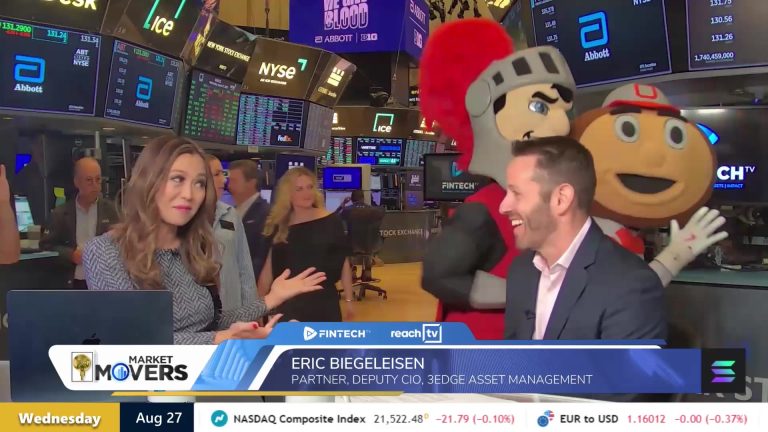
Eric Biegeleisen, Partner, Deputy CIO at 3EDGE Asset Management, joins Remy Blaire at the New York Stock Exchange to discuss the highly anticipated earnings report from Nvidia, a company boasting a remarkable $4 trillion market cap. As the market awaits Nvidia’s earnings announcement, analysts predict an adjusted EPS of $1.01 and revenue of $46.2 billion. Remy and Eric delve into the potential impact of Nvidia’s performance, particularly considering the $8 billion hit the company is expected to report due to recent chip export restrictions to China.

Eric shares his insights on the current market dynamics, expressing concerns about the signs of a bubble forming around artificial intelligence and related technologies. He draws historical parallels to previous market bubbles, such as those associated with railroad stocks and the internet, highlighting the presence of excessive margin lending, momentum trading, and a pervasive “fear of missing out” mentality among investors. Remy emphasizes the importance of distinguishing between noise and signal in today’s social media-driven investment landscape, and Eric explains how his firm utilizes a quantitative investment process to focus on specific data points rather than getting swept up in daily headlines.

The conversation shifts to valuation concerns, with Eric articulating his apprehension about the overvaluation of U.S. markets. He notes that while earnings have increased fourfold since the lows of the global financial crisis, stock prices have surged eightfold, creating a significant disparity that raises questions about the sustainability of current valuations. Eric suggests that this could lead to a necessary adjustment in stock prices.