


The agent in the machine
LHV is giving agentic AI a go, and Grayscale has highlighted the importance of privacy in finance in an AI-driven world.
Of course, LHV isn’t the only bank building agentic AI. According to Accenture, up to 60% of core financial workflows across major institutions have already integrated a form of agentic autonomy. Like many banks trialling or rolling out their AI products, LHV’s focus is not on retail automated decision making for retail customers for now.
Agentic AI means the systems don’t just advise; they act. An agent can monitor a customer’s cash flow, identify a refinancing opportunity, initiate an application, and negotiate a rate, all without a human lifting a finger. Here are some of the ways this will reshape finance:
- Hyper-personalization at scale: agents will construct financial plans tuned to individual circumstances, updating them in real time as income, markets, and life events shift.
- Frictionless execution: the gap between financial advice and financial action collapses, agents become both planner and broker.
- Proactive risk management: rather than alerting customers to problems after the fact, agents will anticipate and neutralize threats, from overdrafts to fraud, before damage is done.
It is a lazy person’s dream.
Yet the risks are equally significant. For businesses, liability becomes murky when an autonomous system makes a poor trade or misses a disclosure. Banks that fail to manage hallucination and autonomous error risks could face severe reputational and financial damage. For consumers, the delegation of financial decisions to software raises painful questions about accountability and manipulation. Agents operating across jurisdictions and at machine speed will outpace existing frameworks designed for human-paced transactions.
A lazy person’s nightmare.
So What?
How much efficiency do we want? And is our inefficiency inadvertently part of the safety design of our transactions?
The issue is similar to cash and privacy. When cash was first created, it was not private by design. It was a bearer asset, but the purpose was ease of payment rather than specifically to keep the payer anonymous. When developing digital cash, and looking to mimic these elements – though this time on purpose – how much privacy is the right amount of privacy? This is something the developers of the ZCash protocol have thought about considerably. Similarly, we’re not necessarily inefficient by design, but some of our safety rails are built into our inefficiencies.
Byron Gilliam, of Blockworks fame, recently quoted Jerry Seinfeld’s interview, in which he explained the importance of taking time, meticulously planning every detail: “If you’re efficient, you’re doing it the wrong way.”
Seinfeld isn’t right about everything, but the utility of efficiency is the question banks, regulators, and consumers will be asking – and they’d best do it quickly.
Markets Today
Bitcoin traded at $67,545 early Tuesday morning but has fallen again to just above $66,000. The near-term outlook is clouded. Demand relative to supply has plunged to 1.3x from over 5x, spot ETF inflows have cooled, and stablecoin growth has stalled, all signaling a lack of fresh capital entering the market. Major altcoins are down 3% to 8% on the week as March closes with sweeping losses across risk assets.
The geopolitical picture shifted Monday when the Wall Street Journal reported that President Trump told advisers he is willing to end the U.S. military campaign against Iran even if the Strait of Hormuz remains largely closed, a report that sent S&P 500 futures up 0.8% and pushed WTI crude off an earlier high of $107 to settle near $103.
The relief, however, is fragile. The S&P 500 is on its longest daily losing streak since 2022, and the MSCI Asia Pacific index is on course for its worst month since the 2008 financial crisis. Even with a ceasefire, a closed Hormuz would mean oil prices would remain elevated, keeping inflation expectations unanchored and the central banks’ easing timeline uncertain.

Tale to tell?
We want to hear from you
New colleagues, new products, new regulatory status, new insight on the future of finance and digitalization? We want to spread your news.
Fintech Business News
Bitcoin faces a quantum reckoning, banks bet big on AI, and crypto on Square
Google’s quantum research puts Bitcoin’s Taproot upgrade in the crosshairs
- Google’s Quantum AI team warned that breaking Bitcoin’s cryptography may require fewer than 500,000 physical qubits.
- The findings cast fresh scrutiny on Taproot, Bitcoin’s 2021 upgrade.
- Google has set a 2029 deadline for its own post-quantum migration, while Bitcoin has no coordinated plan.
Square flips the switch on bitcoin payments for millions of U.S. merchants
- Square has begun enabling bitcoin payments for millions of eligible U.S. sellers.
- Transactions are converted to dollars at checkout with no processing fees through 2026.
Grayscale makes the case for Zcash as AI sharpens the privacy question
- Grayscale argued that rising AI surveillance could make financial privacy more valuable.
- Zcash’s selective disclosure tools may give it a compliance advantage.
Metals.io brings tokenized uranium, gold, and rare earths to blockchain rails
- Metals.io launched with tokenized uranium, gold, and rare-earth metal exposure.
- The tokenized commodities market stands at approximately $7 billion.
LHV Bank tests agentic AI on the front line of customer service
- LHV Bank is exploring agentic AI in retail customer service through a proof of concept with Gradient Labs.
- The pilot is focused on email-based communications with human oversight.
HSBC hands AI a seat at the C-suite table
- HSBC announced David Rice as its first Chief AI Officer effective April 1.
- The role is designed to lead enterprise AI adoption and personalized customer-facing services.
ICYMI
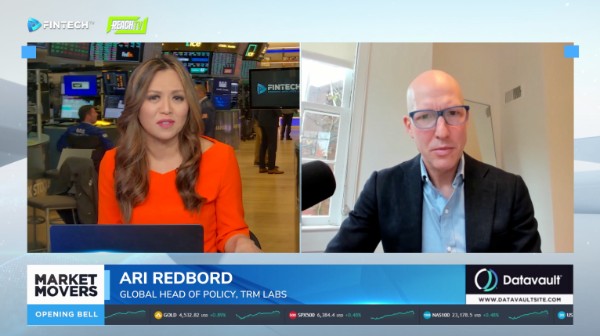
The Rise of Prediction Markets: Unpacking the $20 Billion Surge
Ari Redbord, the Global Head of Policy at TRM Labs, discusses the growth of prediction markets and the influence of high-stakes geopolitical events and macroeconomic factors.
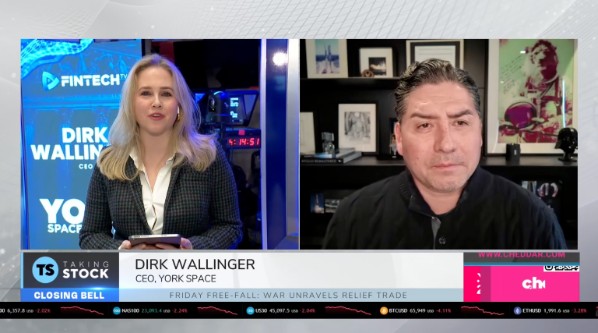
Revolutionizing Satellites & the Future of Space Defense
York Space Systems is shaking up the aerospace and defense industry after its $630 million IPO, with a faster, lower-cost model for building satellite constellations at scale.
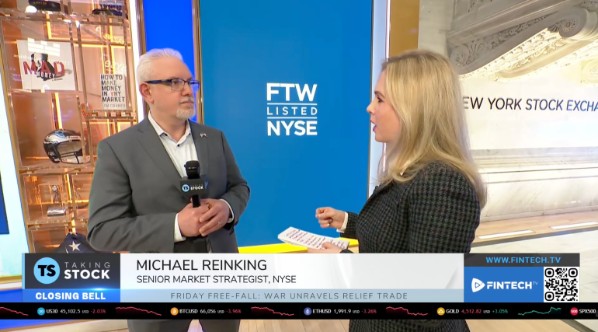
Oil, Interest Rates, and War: What’s Driving Market Volatility
Senior Market Strategist at NYSE, Michael Reinking, explains why investors are showing risk aversion and what suggests markets may be approaching a short-term oversold condition.
The Policy Watch
Digital asset ownership, crypto in 401(k) plans, and a crackdown on insider trading at prediction markets for federal officials
England sets a new standard for digital asset ownership
- The UK Jurisdiction Taskforce published its Report on Control of Digital Assets following the Property (Digital Assets etc.) Act 2026.
- The publication strengthens English law’s position as a leading jurisdiction for digital asset litigation.
Labor Department opens the door to crypto in 401(k) plans
- The U.S. Department of Labor proposed a rule that could make it easier for 401(k) plans to include alternative assets such as crypto.
- The proposal enters a 60-day public comment period before any final rule is issued.
Democrats push for crackdown on insider trading in prediction markets
- More than 40 Senate and House Democrats urged regulators to clarify that insider trading laws apply to prediction markets.
- A bipartisan group also introduced the Public Integrity in Financial Markets Act of 2026.