[stock-market-ticker symbols=" ^NYA;CRYPTO:BTC;CRYPTO:ETH;CRYPTO:USDT;CRYPTO:USDC;CRYPTO:BNB;CRYPTO:ADA;CRYPTO:XRP;CRYPTO:SOL;CRYPTO:DOGE " stockExchange="NYSENASDAQ" width="100%" transparentbackground=1 palette="financial-light"]

Home Blog Page 97

The Business of Sports with Rick Horrow

Dr. Tywanna Smith, International Sports Manger, Professor & Award-Winning Filmmaker, and Co-Founder of Athletes Abroad Summit, joins Rick Horrow on this week’s episode of the Business of Sports.

Rick Horrow brings decades of expertise in sports business, infrastructure development, and public-private partnerships. As Chairman of Horrow Sports Ventures, he has structured over 100 deals valued at more than $20 billion, pioneering innovative funding strategies that have driven major sports, performing arts, and urban development projects. Known as “The Sports Professor,” Horrow has worked with major sports leagues, including the NFL, NHL, MLB, PGA Tour, NASCAR, and Major League Soccer, playing a key role in stadium and arena deals across the U.S. and internationally.

Horrow has built a distinguished media career as well, such as “The Icons with Rick Horrow” and “On The Record”. A Harvard Law graduate and industry thought leader, his expertise continues to shape the business of sports on a global scale. He has also authored four books, including When the Game Is on the Line: From the Man Who Brought the Heat to Miami and the Browns Back to Cleveland, an Inside Look at the High-Stakes World of Sports Deal-MakingThe Sport Business Handbook: Insights from 100+ Leaders Who Shaped 50 Years of the Industry, and Beyond the Box Score: An Insider’s Guide to the $750 Billion Business of Sports. He has been identified as the Visiting Expert on Sports Law at the Harvard Law School, authoring the first sports law and analytical thesis at his alma mater. His expertise continues to shape the business of sports on a global scale.
Fumihide Esaka on the Future of AI and Smart Devices

0

Fumihide Esaka, Chief Executive Officer of Ambiq Micro, joins Remy Blaire at the New York Stock Exchange to discuss Ambiq Micro, a Texas-based company that has recently made headlines by going public on the New York Stock Exchange under the ticker symbol AMBQ. Ambiq Micro, founded in 2010, specializes in ultra-low power chips designed for a variety of edge devices, including smartwatches and glasses. As the demand for AI chips continues to surge, Ambiq is positioning itself to support not only consumer electronics but also AI data centers and automotive technology.

Fumihide shares insights into Ambiq’s innovative technology platform, known as Spot Technology, which allows semiconductors to operate below conventional voltage thresholds. This breakthrough enables energy efficiency that is nearly five times greater than traditional semiconductors, making it a game-changer for AI applications that typically require significant power.

Lastly, Fumi touches on Ambiq’s strategy for expanding into higher-performance markets. Fumi revealed that the company has already shipped millions of chips, generating $270 million in revenue, and is now focused on enhancing its engineering capabilities to meet the growing demand for advanced AI functionalities. 

Revolutionizing Fintech: Timur Turlov on Freedom Holding’s Vision for Central Asia and Beyond

“the Central Asian market, especially the Kazakhstanian market, is growing at a very high level because the population itself is very tech optimistic.” – 01:02

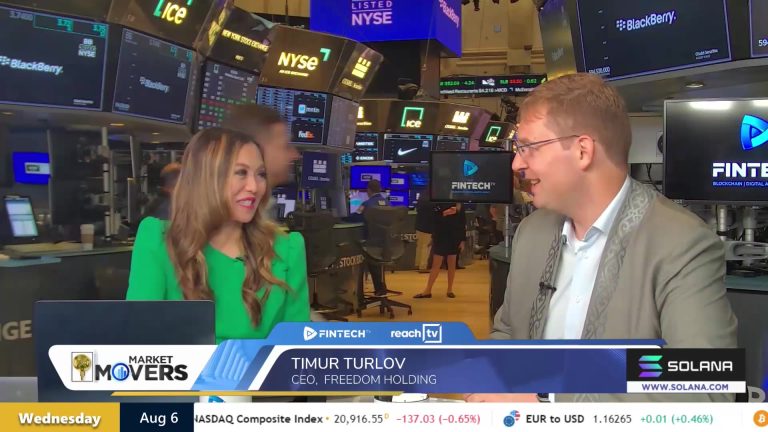
Timur Turlov, CEO of Freedom Holdings, joins Remy Blaire at the New York Stock Exchange to discuss the company’s ambitious initiatives and the broader implications for Central Asia’s digital economy.

The conversation begins by exploring the Freedom Cloud, a significant investment aimed at addressing the infrastructure deficits in Kazakhstan. Timur highlighted the tech-savvy nature of the local population and the rapid development of fintech services in the region. He explains how the government and financial institutions have struggled to accurately forecast their computing needs, leading to a shortage of resources. Freedom Holding’s investment in data centers is a strategic move to not only support its own operations but also to assist other market participants in building their cloud infrastructure.

Finally, the pair touch on Freedom Holding’s growth plans in the U.S. Timur expresses confidence in replicating the successful strategies employed in Kazakhstan within the American market. With the backing of significant capital and investor access, he envisions building a robust fintech presence in the U.S., leveraging the lessons learned from their operations in Central Asia.

Streaming Success: How Spotify and Universal Music Group Are Shaping the Market

“Music is a very uncorrelated asset class. It doesn’t really swing with the tides of the markets.” – 01:01

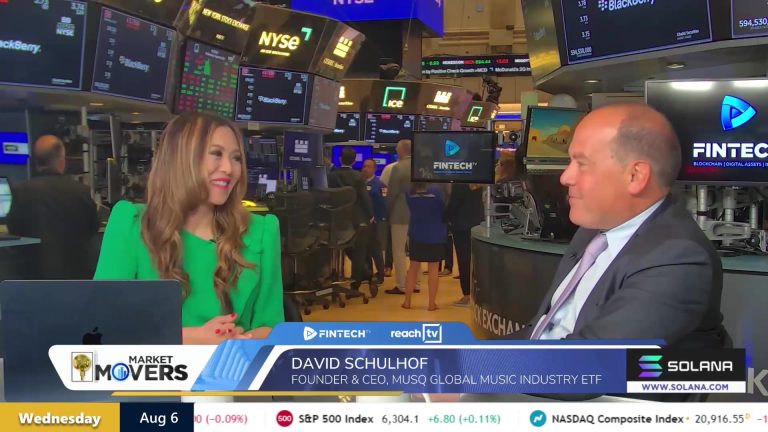
David Schulhof, MUSQ Global Music Industry ETf, joins Remy Blaire at the New York Stock Exchange to discuss the dynamic world of the music industry and its financial implications.

David explains why music is considered an uncorrelated asset class, resilient to market fluctuations and tariffs, and emphasizes its undervaluation and under-monetization. He shares insights into MUSQ’s impressive year-to-date performance, up 18-19%, and discusses the potential for streaming services to continue raising prices to align with competitors like Netflix and Hulu.

Transitioning to earnings season, David provides an analysis of Spotify and Universal Music Group’s recent results, noting strong fundamentals and growth in monthly active users and paid subscribers. He expresses optimism about upcoming reports from Live Nation, anticipating positive outcomes.

Navigating the S&P 500: The Role of Active Management in a Bull Market

0

“Without active management and the ability to look different and concentrate against your highest conviction ideas, it’s very difficult to actually generate outperformance in an environment like this.” – 01:30

Andrew Choi, Portfolio Manager at Parnassus Investments, joins Remy Blaire to delve into the current state of the S&P 500 and the advantages of actively managed ETFs in today’s market. With the S&P 500 up 7% year-to-date, the pair explore how the largest market cap stocks, particularly the MAG 7 names along with Berkshire Hathaway and Broadcom, are driving the index’s performance.

Andrew highlights the challenges of generating outperformance in a market dominated by a select few companies, emphasizing the importance of active management. He shares insights into his fund’s approach, which focuses on a concentrated portfolio of high-conviction ideas, allowing for significant differentiation from the broader index.

Lastly, Andrew shares his thoughts on compelling investment opportunities, particularly in the realm of AI. He points to major players like Microsoft, Alphabet, and Amazon, as well as innovators in life sciences, as key areas to watch for growth driven by technological advancements.

Navigating Economic Uncertainty: The Impact of Recent Jobs Data on the Fed’s Strategy

“Last week’s jobs report really does change the narrative.” – 02:28

James Knightley, Senior International Economist at ING, joins Remy Blaire at the New York Stock Exchange to discuss the significant developments surrounding the U.S. economic landscape, particularly in light of recent actions taken by the White House and the implications for the Bureau of Labor Statistics (BLS). Following President Trump’s dismissal of the BLS commissioner after a disappointing jobs report, the pair explore the growing concerns regarding the credibility of U.S. economic data. With sharp downward revisions to payroll numbers for May and June, trust in these statistics is under scrutiny, leading to unease among investors on Wall Street.

James breaks down the ramifications of the recent jobs report, which has raised questions about the reliability of economic data moving forward. James highlights a shift in behavior since the pandemic, where respondents to data requests have become less reliable, resulting in lower quality data. He emphasizes that while politics plays a role, the primary concern lies in the data collection process itself.

James also delves into the latest GDP data, where he points out the importance of considering both the first and second quarters together to understand the underlying economic trends. He notes that while the headline GDP figure appears strong, domestic demand, particularly consumer spending, is showing signs of weakness, which could prompt the Fed to act sooner rather than later.

Navigating Market Uncertainty: The Rise of Options Income ETFs

“Option income ETFs offer a way to deal with that uncertainty.” – 01:06

John Burello, Senior Portfolio Manager at Invesco’s Income Advantage ETF Suite, joins Remy Blaire to discuss the growing popularity of options income ETFs, particularly in the context of the current market volatility that has characterized 2025.

The discussion begins by John breaking down the inherent risks of options trading for retail investors, where incorrect predictions can lead to calls or puts expiring worthless. However, John highlights how options income ETFs can provide a solution by generating income through various options strategies, such as selling call or put options on underlying stocks or indexes. These funds aim to enhance income while potentially reducing risk and volatility in a portfolio, making them an attractive option for investors navigating uncertain market conditions.

John emphasizes that the surge in interest for these ETFs is largely due to the current market uncertainty surrounding stocks and interest rates. He explains that options income ETFs allow investors to remain engaged in the stock market while benefiting from monthly income that is less sensitive to interest rate fluctuations, ultimately providing a smoother investment experience.

Finally, John breaks down the performance profile of the Income Advantage ETFs across various market regimes. John explains that these ETFs are designed to outperform in down and flat markets due to their conservative approach and income generation, while acknowledging that they may underperform in sharply rising markets. This balanced approach allows investors to navigate different market conditions effectively.

Project Crypto: The SEC’s Bold Move to Modernize Securities Regulations

“One of the key benefits is the efficiency that it brings to the trading and issuance of equities and other types of securities.” – 01:32

Kristin Smith, President of Solana Policy Institute, joins Remy Blaire to discuss the SEC’s newly unveiled initiative, Project Crypto, which aims to modernize securities regulations to better accommodate crypto-based trading. As interest in tokenization—the process of creating digital representations of securities on a blockchain—continues to surge, SEC Chair Paul Atkins has emphasized the importance of avoiding rigid regulations that could drive crypto companies offshore.

Kristin breaks down the Solana Policy Institute’s involvement in Project Open, where they submitted a comprehensive legal framework to the SEC’s Crypto Task Force. Kristin explains how Project Open aligns with Project Crypto, emphasizing the collaborative efforts among various stakeholders in the Solana ecosystem to identify regulatory barriers and propose solutions. She praised the SEC’s Crypto Task Force for their extensive engagement with stakeholders, having conducted over 150 meetings to gather input and suggestions.

Lastly, the pair touched on the recent policy roadmap released by the White House’s President’s Working Group on Digital Asset Markets. Kristin highlights the report’s significance in signaling a shift from questioning whether crypto will be integrated into the financial system to focusing on how that integration will occur. She expresses enthusiasm for the report’s detailed blueprint, which outlines the roles of various agencies, including Congress and the SEC, in fostering a conducive environment for crypto innovation in the United States.

Corporate Crypto Treasuries: Are Companies Betting on Bitcoin?

“We’re seeing a few different streams, whether it’s Congress, regulatory agencies, or the White House itself, really kind of willing to partner and listen to industry advocates.” – 03:34

Patrick Liou, Director of Institutional at Gemini, joins Remy Blaire at the New York Stock Exchange to discuss the current state of the cryptocurrency market, particularly focusing on Bitcoin and major altcoins as they attempt to recover from a recent downturn triggered by disappointing U.S. jobs data.

Patrick provides valuable insights into the recent trading activity across various asset classes, with a specific focus on cryptocurrencies. Patrick discusses Bitcoin’s recent price movements, noting that it has dipped from its highs around $120,000 to approximately $112,000, largely due to macroeconomic factors. Despite this pullback, he emphasizes that July marked Bitcoin’s highest monthly close ever, suggesting that such dips can be healthy and corrective.

Finally, the pair explore the recent approval of inclined ETF trades by the SEC and what this means for institutional access to cryptocurrencies. Patrick explains how this development simplifies the process for traditional investors and enhances operational efficiencies within the crypto market.

Fed Rate Cut Expectations Rise Amid Mixed Labor Market Data

“We’re now looking at markets pricing in about a 90% probability of a cut in September.” – 03:27

Michael Reinking, Senior Market Strategist at the NYSE, joins Remy Blaire to discuss the latest developments in the U.S. economy, particularly focusing on the implications of recent labor market data and the rising expectations for Federal Reserve rate cuts. The pair begin by breaking down the latest U.S. jobs report, which revealed that nonfarm payrolls came in below estimates, with a notable increase in unemployment.

Shifting focus to the trading floor, a remarkable week for mergers and acquisitions (M&A), marking the highest volume of deals since 2021. Notable transactions included Union Pacific’s $71.5 billion acquisition of Norfolk Southern and Palo Alto Networks’ $25 billion deal for CyberArk. The successful IPO of software company Figma, which saw its share prices more than triple, adds to the optimism surrounding the market, indicating a revival in the IPO landscape.

As the pair wrap up, they touch on the earnings reports from major tech companies, highlighting the strong performance of names like Alphabet, Meta, and Microsoft, while also acknowledging the mixed results from Amazon.