[stock-market-ticker symbols=" ^NYA;CRYPTO:BTC;CRYPTO:ETH;CRYPTO:USDT;CRYPTO:USDC;CRYPTO:BNB;CRYPTO:ADA;CRYPTO:XRP;CRYPTO:SOL;CRYPTO:DOGE " stockExchange="NYSENASDAQ" width="100%" transparentbackground=1 palette="financial-light"]

Home Blog Page 91

Engineering the Capital Network: Insights from Abu Dhabi Finance Week 2025

0

Remy Blaire welcomes Emmanuel Givanakis, the CEO of the Financial Services Regulatory Authority at ADGM. The discussion centers around the upcoming Abu Dhabi Finance Week (ADFW) 2025, which is recognized as the MENA region’s leading business and investment summit.

Remy introduces the significance of ADFW 2025, highlighting that it will bring together global leaders, market experts, policymakers, and investors from over 100 countries. The event spans four dynamic days and features five flagship forums along with more than 60 curated events aimed at unlocking opportunities, fostering partnerships, and accelerating economic growth. This year’s theme, “Engineering the Capital Network,” focuses on the creation of innovative financial systems that leverage technology, particularly artificial intelligence (AI), and adapt to the shifting landscape of global capital flows.

Emmanuel shares that ADFW 2025 is set to be larger and more impactful than previous editions, with over 300 speakers and leaders managing assets totaling up to $60 trillion—nearly half of the world’s GDP. Remy inquires about the key themes expected to emerge from the event, and Emmanuel outlines that discussions will revolve around global economic macro themes, asset management, private markets, and the growing trend of tokenization. He emphasizes the movement towards greater digitization of financial services and the necessity for global collaboration to enhance capital efficiency.

As the conversation progresses, Remy asks Emmanuel to highlight specific areas that will be in the spotlight during the event. Emmanuel mentions infrastructure investment, energy transition, and AI, particularly on the designated tech day of the summit. He also discusses the fourth edition of the Global Regulators Summit, which will focus on private credit and private markets, stressing the importance of regulatory engagement in these rapidly evolving sectors.

Remy then prompts Emmanuel to elaborate on the significant regulatory developments introduced by ADGM in the past year. Emmanuel details the introduction of a new cybercrime framework, enhancements to the virtual asset crypto framework, and initiatives surrounding stablecoins and fund reporting. He underscores ADGM’s commitment to innovation and the need to keep pace with industry advancements.

Innovating Against Overdose: Collin Gage’s ARMR Sciences on the Future of Synthetic Drug Defense

Jane King engages in a compelling discussion with Collin Gage, the Founder and CEO of ARMR Sciences, about the escalating threat of synthetic opioids, particularly fentanyl. The conversation begins with Jane highlighting the alarming statistics surrounding fentanyl, noting that just one kilogram can potentially kill up to 500,000 people. Collin emphasizes that this crisis has evolved from a public health issue into a national security threat, with the potential to devastate entire cities.

Collin explains that ARMR Sciences is at the forefront of addressing this crisis with their innovative immunotherapy platform designed to neutralize synthetic drugs. Their flagship product, Armr-100, aims to train the body’s immune system to recognize and block fentanyl before it can cause harm. He elaborates on the science behind Armr-100, describing how it elicits an immune response that produces protective antibodies, effectively creating a biological shield against fentanyl and preventing it from attacking the brain.

“Our goal is to really create new, preventative, long-lasting countermeasures for these drug threats.” – 01:38

The discussion takes a poignant turn as Collin addresses the risks faced by first responders, who are often exposed to fentanyl without adequate protection. He draws a parallel to the past, when first responders lacked bulletproof vests, underscoring the urgent need for modern defenses against these new synthetic drug threats.

“We need to arm our first responders, our military, to the best of our ability.” – 02:54

Collin also shares insights into the support ARMR Sciences has received from the Department of Defense, which has funded much of their early-stage research. He reveals that their product has shown promising results, blocking up to 98% of fentanyl from reaching the brain and completely negating its addictive and analgesic effects. This is particularly significant for individuals struggling with opioid use disorder, as it provides them with a safer path to recovery.

As the segment concludes, Collin discusses ARMR Sciences’ plans for an initial public offering (IPO) in the near future, with a reserved stock ticker symbol, ARMR. He encourages listeners to stay tuned for updates on their progress as they continue their vital work in combating the fentanyl crisis.

This content is brought to you by ARMR Sciences.

October’s Crypto Conundrum: Market Pullbacks and Institutional Momentum

“Powell’s remarks yesterday sent a jitter through the system.” – 01:03

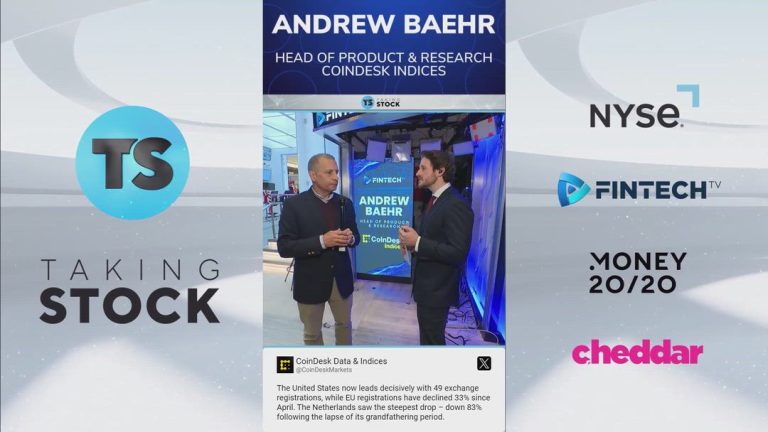
Andy Baehr, Head of Product & Research at Coindesk Indices, discusses the current state of the cryptocurrency market as October 2023 comes to a close. The segment opens with a reflection on the recent pullback of major cryptocurrencies following the Federal Reserve’s latest meeting, highlighting the disappointing performance of the market throughout the month. Retail traders are particularly affected, with many engaging in leveraged positions and facing liquidation events.

The ongoing U.S. government shutdown is identified as a significant factor contributing to the stalled regulatory progress in the crypto space. Andy notes that the market is still recovering from a deleveraging event that occurred on October 10th, indicating a need for a catalyst to stabilize and regain momentum.

As the conversation progresses, Andy shifts focus to the recent launches of exchange-traded funds (ETFs), particularly those related to Solana. He explains the importance of these developments for investors and provides insights into Solana’s unique features as a layer one blockchain. Andy compares Solana to Ethereum, emphasizing its faster and cheaper transaction capabilities, as well as its U.S.-centric foundation that is eager for business.

The discussion also covers the recent partnerships Solana has formed, including an announcement with Western Union for a stablecoin, positioning it as a competitive player in the blockchain ecosystem. Andy elaborates on the growing trend of launching stablecoins on Solana and the advantages it offers over Ethereum’s layer two networks.

The ETF Boom: Exploring Record Inflows and Innovations in 2025

“There are actually more active ETFs now listed than passive ETFs, which is astounding.” – 01:35

Remy Blaire engages in a compelling discussion with Burke Ashenden, the VP of Capital Markets and Institutional Strategy at Innovator Capital Management. The segment focuses on the remarkable growth and evolution of Exchange-Traded Funds (ETFs) in the current financial landscape.

Remy begins by highlighting recent developments in the ETF space, including Grayscale’s celebration of its new multi-token crypto fund and Bitwise’s launch of a Solana staking ETF. She notes that ETFs are on track for another record-breaking year, with expectations of over $1 trillion in new inflows, following a historic performance in 2022. Burke emphasizes that this year has been a “juggernaut” for ETFs, coining the term “triple crown” to describe the record flows, launches, and trading volumes.

As the conversation unfolds, Burke explains the significant shift towards active ETFs, which now account for one-third of flows, a stark increase from previous years when they represented only a small percentage. He discusses the emergence of options-based and derivative-based ETFs, such as buffer ETFs, which are gaining traction in the market. This evolution reflects a broader penetration of ETFs into various market segments, moving beyond their traditional role as low-cost passive investment vehicles.

Remy and Burke also explore the increasing interest from institutional investors, including pensions and endowments, who are reevaluating their investment strategies. Burke points out that these institutions are now looking to ETFs for their liquidity and cost-effectiveness, especially in a turbulent political environment. He explains that many institutions are seeking to replace expensive hedge fund strategies with more accessible ETF options that still provide risk management.

The discussion shifts to the intersection of ETFs and digital assets, where Burke notes a significant change in institutional attitudes towards cryptocurrencies. He highlights that institutions are now more willing to invest in crypto ETFs, allocating a small percentage of their risk budgets to assets like Bitcoin. Burke emphasizes the importance of managing volatility in these investments and suggests that buffer ETFs can serve as a protective measure.

Transforming Bitcoin: From Digital Gold to Financial Infrastructure

“It’s one thing to think about Bitcoin as the asset, but now we can start thinking of it as settlement rails.” – 01:20

Remy Blaire engages in a thought-provoking discussion with two prominent figures in the cryptocurrency space: Matt Mudano, CEO of Arch Network, and Josh Gordon, CEO of HoneyB. The conversation centers around the evolving role of Bitcoin as it transitions from being viewed primarily as digital gold to becoming a foundational layer for a new financial system.

Remy opens the segment by highlighting the insights of investors like Tom Lee and Matt Hogan, who have pointed out the DeFi capabilities of Ethereum and Solana, particularly in areas such as tokenization and stablecoins. She notes that Bitcoin is now expanding into these domains, introducing HoneyB as the first Bitcoin-native platform designed for compliant tokenization of traditional real-world assets, developed in partnership with Arch Network.

The discussion begins with Matt Mudano explaining how Bitcoin, initially created to address the double spending problem, is now evolving into a financial infrastructure that supports real economic activity. He emphasizes that Arch Network’s role is to enhance Bitcoin’s functionality by creating a programmable layer that operates directly on the Bitcoin network, allowing it to serve as a settlement layer.

Josh Gordon then shares his vision for HoneyB, detailing the challenges faced by investors seeking returns on their Bitcoin holdings. He explains that the current methods of generating yield, which have relied on basis trade strategies and token emissions, are neither scalable nor sustainable. Josh outlines his efforts to integrate private credit and fixed income markets with institutional Bitcoin, aiming to create a more robust and sustainable yield environment.

The conversation shifts to the historical difficulties of programmability on Bitcoin. Matt elaborates on how Bitcoin’s design has prioritized security and simplicity, which has limited its programmability compared to other blockchain platforms. However, he points out that recent upgrades to Bitcoin’s core architecture have enabled the storage of arbitrary data, paving the way for innovations like Arch Network that can enhance Bitcoin’s capabilities without compromising its security.

Josh further explains how institutions can now leverage their Bitcoin holdings to generate yield without losing custody or exposing themselves to the risks associated with DeFi smart contracts. He describes how HoneyB allows institutions to maintain their Bitcoin with trusted custody providers while utilizing the Arch ecosystem to create derivatives and access stablecoin yields.

Polymarket relaunch, OpenAI pivot, Securitize IPO, France bitcoin

0

In this episode of Coin Street headlines, we dive into the latest developments in the world of cryptocurrency and technology. PolyMarket is set to relaunch in the U.S. this November, focusing on sports betting after a favorable decision from regulators. OpenAI has restructured into a public benefit corporation, allowing for greater capital flexibility and securing a significant stake for Microsoft. Securitize, a leader in real-world asset tokenization, is going public through a merger with a SPAC, aiming to democratize capital markets. In France, lawmakers are considering a proposal that could reshape the country’s approach to digital currencies, including a potential ban on the digital euro. Jane King with the latest from the NYSE

Convergence of Crypto and AI: Exploring New Use Cases at Money20/20

“We think that the moment’s ripe for investors to not just consider crypto as an allocation, but also to look into diversified allocations.” – 02:31

Remy Blaire engages in a compelling conversation with Bruno Caratori, the Co-Founder and COO of Hashdex, during the final day Money20/20 conference in Las Vegas. Remy and Bruno delve into the current state of the crypto market, particularly focusing on the volatility that has characterized 2025.

Bruno shares his perspective on the inherent volatility of the crypto industry, drawing from nearly eight years of experience in the field. He explains that this volatility is a natural aspect of the asset class, influenced by external factors such as macroeconomic conditions and geopolitical uncertainties. Despite the fluctuations, Bruno expresses optimism about the long-term outlook for crypto, suggesting that while volatility may persist, historical data indicates a potential for stabilization over time.

The discussion shifts to NCIQ, a crypto exchange-traded product (ETP) recently launched by Hashdex in the U.S. Bruno highlights that NCIQ is distinct from earlier products that focused solely on Bitcoin or Ether, as it aims to follow a diversified index—the NCI (Mazda Crypto Index)—which represents the broader crypto market. He emphasizes the importance of diversification in crypto investments, asserting that the market extends far beyond just Bitcoin and Ether, and that other crypto assets are likely to gain value as new use cases emerge.

A key theme of the conversation is the convergence of crypto and artificial intelligence (AI). Bruno notes that this year’s conference has showcased a growing intersection between these two technologies, with crypto offering solutions to challenges faced by AI, such as proof of identity and content provenance. He expresses excitement about the potential for crypto networks to underpin new marketplaces and monetizable media, indicating that recent developments have revealed significant use cases for crypto, particularly in stablecoins and asset tokenization.

Looking to the future, Bruno predicts that as stablecoins gain mainstream acceptance, AI agents will increasingly facilitate transactions in everyday commerce, such as purchasing tickets or sourcing business inputs. He anticipates that this integration will become a reality within the next 12 to 24 months.

Navigating the Future of Crypto Taxes: Insights from Money20/20

“The regulation really legitimizes and solidifies digital assets’ place within the economy.” – 01:50

Remy Blaire engages in a thought-provoking discussion with Amy Fisher, the Head of Partnerships at Taxbit, during the final day of Money20/20. The conversation centers around the evolving landscape of taxation on digital assets, particularly in light of recent developments in the cryptocurrency industry.

Remy opens the segment by highlighting the ongoing discussions about taxes in the crypto space, noting that while the government may face shutdowns, tax obligations remain. Amy explains that the crypto industry is advocating for clearer tax regulations, especially as the income threshold for 0% long-term capital gains tax has been raised. She emphasizes the growing adoption of digital assets and the emergence of accounting firms specializing in blockchain.

As they delve deeper into the topic, Amy shares insights on the trends observed over the past decade, particularly the convergence of Decentralized Finance (DeFi) with Traditional Finance (TradFi). She points out that as digital assets become more mainstream, compliance rules and regulations are becoming increasingly important. Amy notes that the upcoming regulations set to go live in 2026 in both the U.S. and the EU are crucial for legitimizing digital assets within the economy.

Remy and Amy discuss the uncertainty that has characterized 2025, touching on the geopolitical and policy-related questions that loom over the industry. While Taxbit does not provide direct tax advice, Amy explains that they work closely with major firms like KPMG and Deloitte to ensure their clients receive the best guidance possible. She emphasizes the importance of education in navigating the regulatory landscape and the need for industry stakeholders to collaborate with policymakers to prioritize consumer interests.

Market Momentum: Big Tech and Crypto Insights from Money20/20

“I think we all know we’re already tired of the uncertainty, right, and the terror of the trade war that’s overhanging us for the better half of this year.” – 01:57

Remy Blaire welcomes Tongtong Gong, the Chief Operating Officer at Amberdata, for a live discussion from the Money20/20 conference in Las Vegas. The conversation begins with an overview of the current financial markets, highlighting the recent record highs in U.S. equities, particularly in big tech, while noting the sluggish performance of major cryptocurrencies like Bitcoin and Ethereum, as well as precious metals such as gold and silver.

Remy and Tongtong discuss the factors contributing to the market’s upward momentum, including the anticipation of a 25 basis point interest rate cut from the Federal Reserve. They explore the implications of this potential decision and how it aligns with the expected earnings reports from major companies like Apple, Alphabet, and Meta. Tongtong emphasizes the importance of these developments in shaping investor sentiment.

The discussion then shifts to the geopolitical landscape, focusing on President Trump’s recent trip to Asia and the anticipated meeting with China’s leader, Xi Jinping. Tongtong expresses optimism about the potential for productive dialogue, particularly in light of ongoing trade tensions and issues such as fentanyl and agricultural trade. She highlights the significance of face-to-face meetings in resolving uncertainties that have affected the global economy.

As the conversation progresses, Remy and Tongtong examine the performance of various asset classes as they approach year-end. Tongtong shares her bullish outlook on Bitcoin, predicting it could surge past $120, with hopes for it to reach $140 by the end of the year. This leads to a broader discussion on the implications of fintech and digital assets, especially in the context of the innovations showcased at Money20/20.

Tongtong highlights the growing adoption of cryptocurrencies by major financial institutions and the increasing interest in ETFs and asset tokenization. She notes that regulatory developments, such as the Genius Act and Clarity Act, are helping to reduce uncertainty and foster innovation in the industry.

The Future of Payments: Exploring Stablecoins and Global Adoption

“Stablecoins are the best way that we have to export the U.S. dollar.” – 02:37

Remy Blaire engages in a compelling discussion with Kevin Lehtiniitty, the CEO of Borderless.xyz, as they explore the evolving landscape of stablecoins during the Money20/20 conference in Las Vegas. As the conference comes to a close, Remy and Kevin delve into the significant developments surrounding stablecoins and their implications for the global payments market.

Remy begins by asking Kevin to define what a stablecoin is. Kevin explains that a stablecoin is a blockchain-based asset that is fully backed one-to-one by a fiat currency, such as the US dollar. He uses USDC, Circle’s stablecoin, as an example, illustrating how it maintains its intrinsic value despite market volatility. This foundational understanding sets the stage for a deeper exploration of stablecoins’ role in the financial ecosystem.

As they reflect on the conference, Kevin highlights the increasing interest from institutional and enterprise players in stablecoins, marking a shift from niche discussions among blockchain enthusiasts to mainstream conversations involving well-known brands like FIS, WorldPay, and Wise. He emphasizes that this year’s conference feels like a turning point for stablecoins, as they finally gain the attention they deserve.

The conversation then shifts to the concept of “borderless” finance. Kevin discusses how stablecoins serve as a means to export the US dollar to emerging markets that experience currency instability and high inflation. He points out that in countries like Brazil, Argentina, and Nigeria, consumers are increasingly adopting stablecoins to preserve their purchasing power, showcasing the real-world utility of these digital assets.

Remy and Kevin also address the challenges posed by fragmentation in the stablecoin market. Kevin explains that, unlike traditional payment networks, which have established systems for interoperability, the stablecoin landscape lacks a universal exchange or index. This fragmentation leads to significant discrepancies in liquidity and pricing across different venues, complicating the global payments ecosystem.